
Oral History: Baptism
It was the spring of 1829, and the Prophet Jospeh Smith, with the help of Oliver Cowdery (his mother’s cousin), was in the process of translating the golden plates into what would become the Book of Mormon. Smith and Cowdery had secluded themselves on the Whitmer farm in upstate New York. Surrounded by thick forests and acres of lush green farmland, they spent most of their time in the log cabin farmhouse at work on the religious text. Smith sat at one end of a simple wooden table and Cowdery sat at the other end with paper and a dip pen ready to write. Smith set his old dusty felted beaver fur top hat facing upward on the table and placed his seer stones inside the hat. Bringing the hat close to him, he shoved his face inside it so that no light could get in. Smith said that inside the dark hat he could see a parchment appear before his eyes. The parchment contained a sentence, which he read to Cowdery, who wrote it down. Once Joseph stopped speaking, Cowdery would repeat the sentence back to Joseph. If the translation was correct, new words would appear on the parchment. Smith and Cowdery often discussed what the translations meant, and sometimes made revisions based on their revelations.

On the 15th of May 1829, Smith and Cowdery went into the woods surrounding the farm to pray and enquire of God regarding a recent translation pertaining to baptism by immersion for the remission of sins. They trampled through the thick forest floor until they came to a natural clearing where they could kneel and pray without disruption. As they knelt, Smith called upon the Lord bellowing, “God, our Heavenly Father, we call on thee to be directed in our thoughts. As thy servants, we humbly ask thee to show us in the way of baptism that we may bring forth the everlasting gospel to the men, women, and children of this earth…” Suddenly, Smith and Cowdery were overcome by a shared vision of a heavenly messenger, John the Baptist, who descended upon them in a cloud of light. Laying his hands on both of their heads, he said (1):
Upon you, my fellow servants in the name of Messiah, I confer the priesthood of Aaron, which holds the keys of ministering of angels and of the gospel of repentance, and of baptism by immersion for the remission of sins, and this shall never be taken again from the earth until the sons of Levi do offer again, an offering unto the Lord in righteousness.
Overcome by the vision they fell to the ground and laid there for several minutes. Then, without speaking, Smith and Cowdery stood up and walked to the nearby Susquehanna River. Stripping down to their linen underpants, they waded into the crisp river water. Smith stood next to Cowdery with his left hand holding on to Cowdery’s right wrist and his other hand placed on his back. Cowdery’s right hand held onto Smith’s arm as he was dunked completely under the water, baptized. Then Cowdery baptized Smith in the same fashion.
They waded out of the cold river water and laid shivering in the sun. After what felt like hours, Smith stood up and commanded Cowdery to kneel down. Obedient, Cowdery knelt on the river bank in front of Smith, who placed his hands on his head saying, “Oliver Cowdery, by the spiritual gifts, which have been bestowed by the hand of God, I confer the keys of the Aaronic Priesthood on thee, that thy may serve the Lord and restore the one true church of Christ, be faithful and do which is commanded of thee and you shall be lifted up at the last day” (2). Cowdery stood up, and Smith knelt down, placing his hands on Smith’s head Cowdery ordained him to the Aaronic Priesthood. They staggered back the farmhouse feeling enlightened by the experience, their minds filled with the “Spirit of Prophecy”. With renewed vigor they took to their translation and transcribing work, finishing the entire Book of Mormon manuscript in less than 60 days (3).
Baptism is for those who reach the “years of accountability”, which the Prophet Joseph Smith eventually defined as 8 years old. Baptism by immersion was (and still is) required for membership into the Mormon Church. All converts who have previously been baptized into other churches are required to be baptized into the “new and everlasting covenant” (4). After being baptized members receive the gift of the Holy Ghost (i.e., confirmation) through the laying on of hands. The Holy Ghost bestows spiritual gifts and blessings. Only men who hold the Priesthood are allowed to baptize and confirm members. During the Prophet Jospeh Smith’s life, baptism was also used to clear one of sins or healing (this is no longer practiced). Starting in 1840, the Prophet directed members to perform "baptisms for the dead”, which is when a member of the church is baptized as a proxy for someone who died before being baptized. Baptisms for the dead, although controversial, are still practiced today (5).
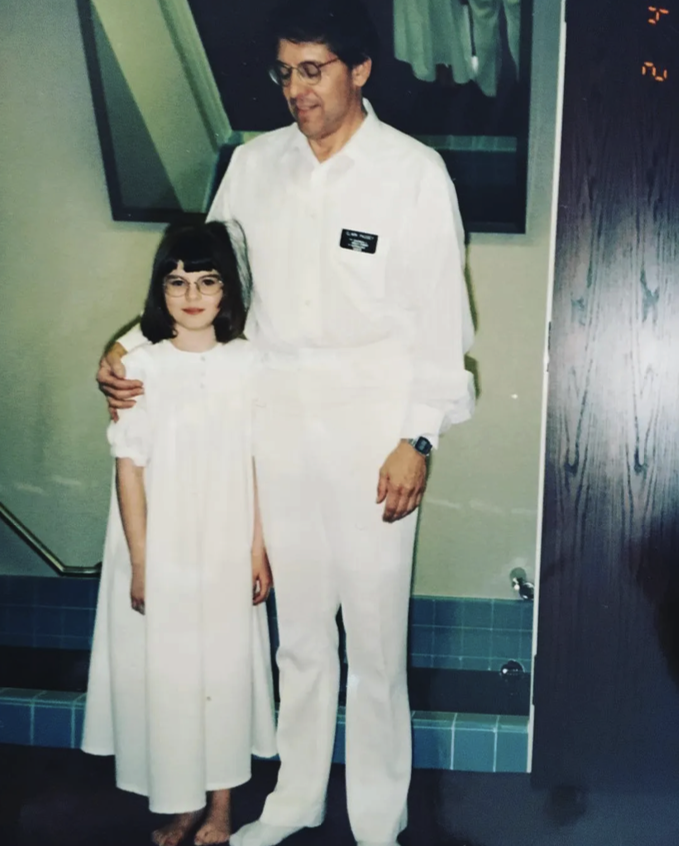
The author on her baptism day
Joseph Smith Papers, History 1838-1856, volume A-1, page 17. https://www.josephsmithpapers.org/paper-summary/history-1838-1856-volume-a-1-23-december-1805-30-august-1834/
Joseph Smith Papers, Glossary, Aaronic Priesthood, https://www.josephsmithpapers.org/topic/aaronic-priesthood
It is argued that Oliver Cowdery should be considered a co-author of the Book of Mormon, as he greatly influenced and progressed the writing of the manuscript. Cowdery’s family attended the Congregational Church and were familiar with The View of the Hebrews (1823), which suggests that Native Americans were descendants of the Hebrew people. Joseph Smith biographer Fawn Brodie believed the parallels between the Book of Mormon and The View of the Hebrews are more than just coincidence. Fawn Brodie, No Man Knows My History (New York: Alfred A. Knopf, 1971), 47.
Josephs Smith Papers, Glossary, Baptism, https://www.josephsmithpapers.org/topic/baptism
https://time.com/4722056/mormon-henry-eyring-dead-baptism/