
Artefact: Flax
Flax was a popular crop in early colonial America. Flax or Linum usitatissimum, meaning linen “most useful", is the ultimate all-purpose plant (1). Mormon pioneers grew flax for a variety of uses.
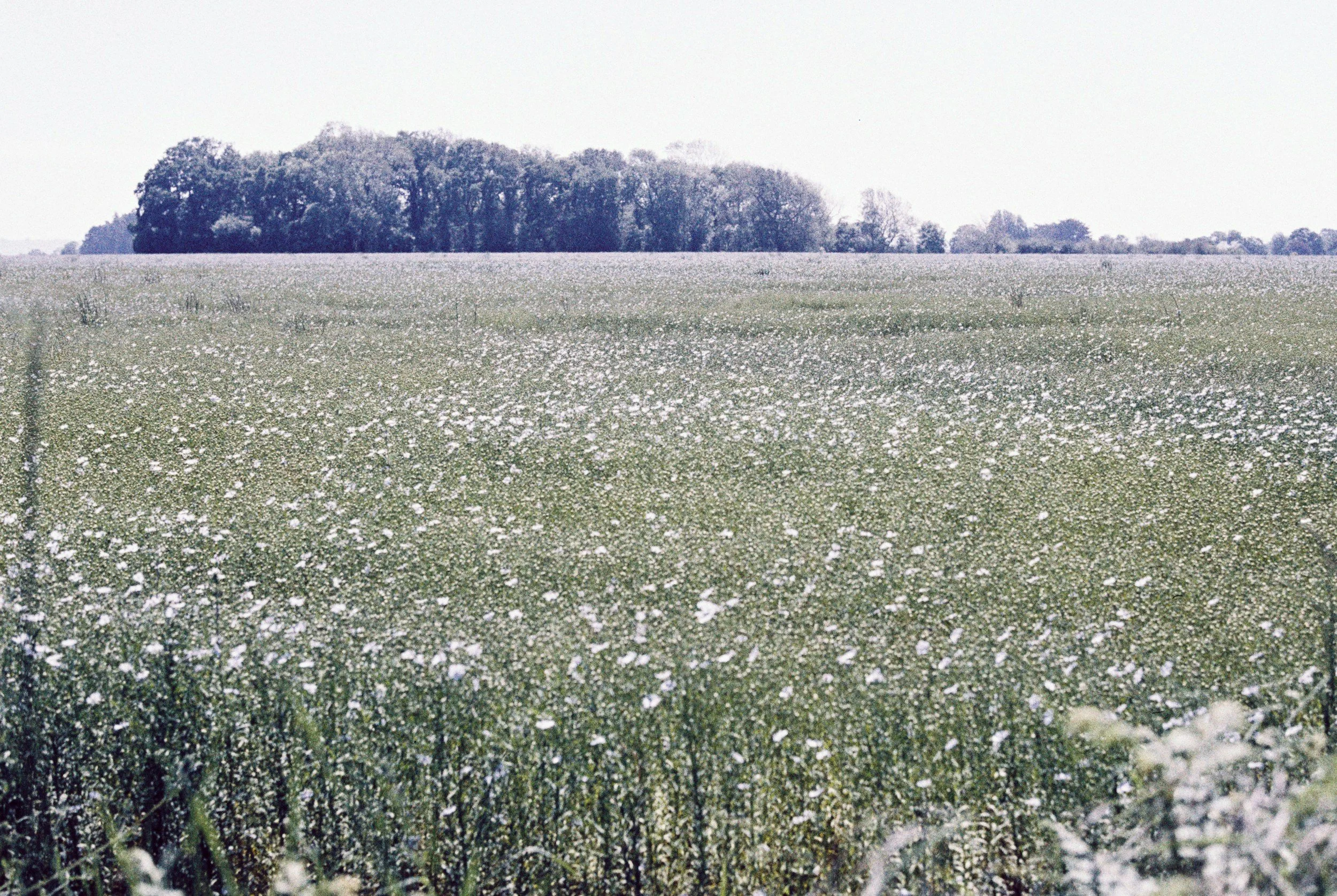
It has beautiful delicate blue flowers
The seeds can be ground up into a nutritious meal
The seeds can be extracted into linseed oil
The fibers can be used to make linen
Flax is a labor intensive crop that requires deep, rich soil. The soil of a newly cleared forest is ideal for flax. It needs to be rotated with wheat and other crops, as flax depletes the nutrients in the soil. Flax seeds are sown in April with seeds spaced close together. Flax roots take up so much space, that when planted close together, there is no room for weeds to take hold. It takes about 100 days for the plant to mature. The flax plant has several properties that make it ideal for spinning into linen fibers (2). It has a woody stalk that, when dried out, is hollow. It is 2-3 feet in length and, when wet, the pectin in the stalk binds the Bbers together. The stalk has nodes (like bamboo) that help join Bber lengths together. Flax fibers are highly absorbent and dry quickly. Additionally, flax fibers have the greatest tensile strength of any natural fiber! Linen sheets can survive for a century or more.
Mormon pioneers grew enough flax to make clothing and linens for the home, and likely used the seeds for meal and linseed oil. The flax plants surrounding the log cabin home would have grown to be slender three-foot plants with beautiful blue blossoms from mid-spring through summer. Mormon pioneers would have cut down the flax stalks about a month after blossoming and let the stalks dry out in the field. The seeds would be removed and saved for culinary uses. Through a series of steps, the flax bundles would be processed to removed unwanted fibers. The women would have spun the fibers into a sturdy thread that was then stretched and boiled to set the twist that is put into by the spinning process. The end product would then be woven into clothing and bed linens. With the need to rotate crops, they likely made enough thread to last them a couple years until the next crop of flax was planted.
Note on Flax in the Book of Mormon
The Book of Mormon tells the history of a group of Hebrews, led by the Prophet Lehi, that leave Jerusalem and come to America in about 600 BCE. This original group populate ancient America and are believed to be the ancestors of Indigenous Americans (3). The Book of Mormon mentions the flax plant several times, e.g., flaxen cord and linen. This is inaccurate as flax (the kind used for linen) was not introduced to North America until Europrean colonization in the 17th century, about 1,000 years after the events of the Book of Mormon (4). Wild blue flax (Linum lewisii) was discovered during the Lewis and Clark expeditions west (5). However, wild blue flax does not produce enough fiber and oil to be cultivated for linen. Indigenous peoples used blue flax as a medicine and source of dietary fiber. There is no evidence that flax (Linum usitatissimum) existed in the New World before the introduction by colonists. However, there is plenty of evidence that Mesoamerican civilizations cultivated and made textiles from agave, yucca, and three species of cotton.
McHughen, A. (1990). Flax (Linum usitatissimum L.): In Vitro Studies. In: Bajaj, Y.P.S. (eds) Legumes and Oilseed Crops I. Biotechnology in Agriculture and Forestry, vol 10. Springer, Berlin, Heidelberg. https://doi.org/10.1007/978-3-642-74448-8_24
https://www.nps.gov/jame/learn/historyculture/flax-production-in-the-seventeenth-century.htm
https://www.britannica.com/topic/Book-of-Mormon
https://exhibitions.psu.edu/s/flax/page/history-of-flax
https://www.nps.gov/cebr/learn/nature/blue-flax.htm
Nadal LF. Mesoamerican archaeological textiles: An overview of materials, techniques, and contexts. InPreColumbian textile conference VII/Jornadas de Textiles PreColombinos VII2017 (p. 7). Lulu. com.